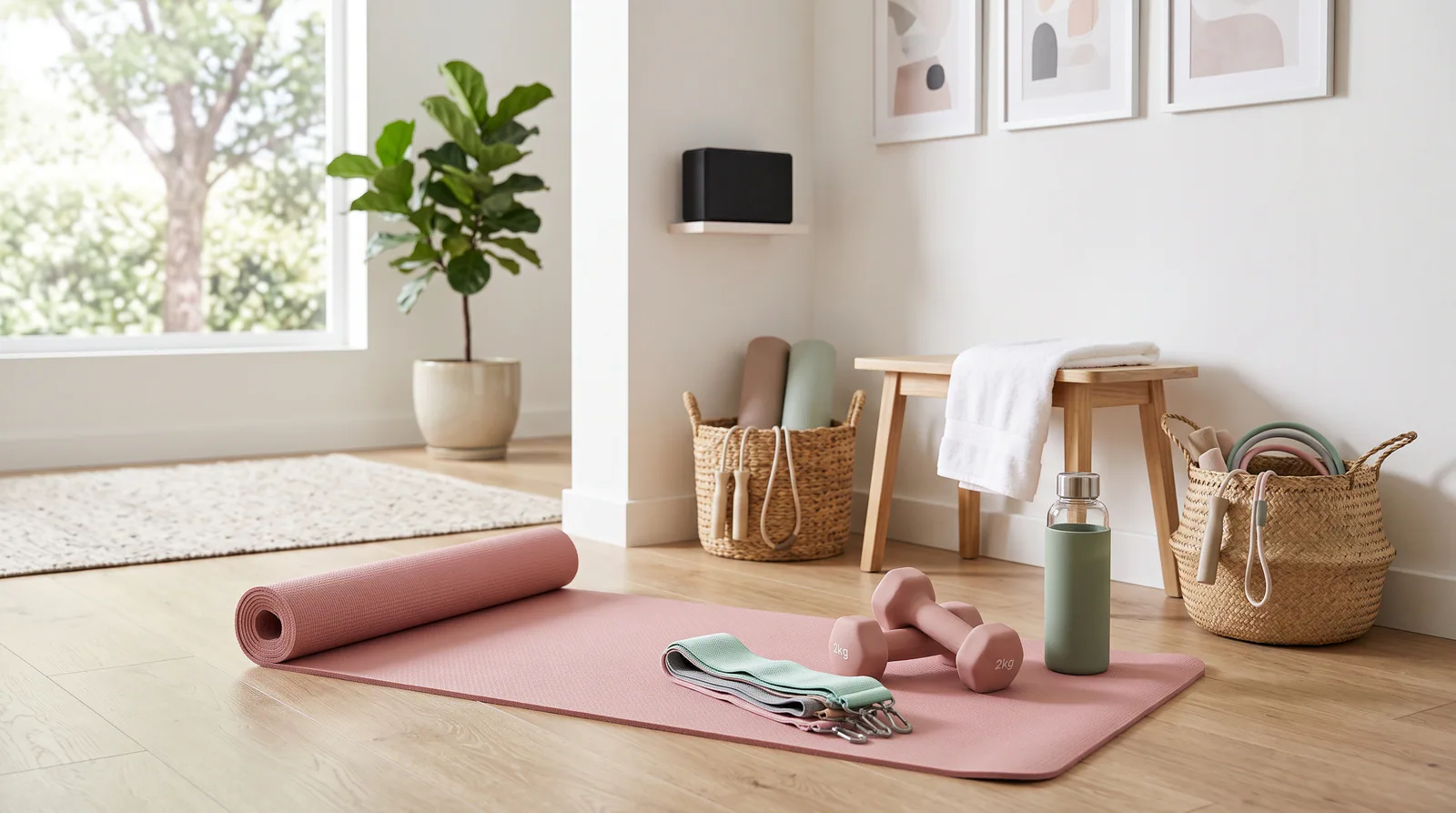
Setting up a home workout space doesn't require turning a spare room, hallway, or corner of a living room into a fully equipped gym. Most of what actually gets used week after week comes down to a small handful of well-chosen pieces of equipment, not a wall of machines. If you're researching home workout equipment for women and wondering where to start, the honest answer is: fewer things than you'd expect, chosen around your space, your goals, and your budget.
This guide walks through what genuinely earns a spot in a home workout setup, what can wait, and how to build toward a routine that fits your apartment, your schedule, and your training goals without overbuying.
Before You Buy Home Workout Equipment
Before comparing individual products, it helps to answer four questions. They'll do more to shape a smart purchase than any spec sheet.
Space. How much floor area can realistically be dedicated to working out, even temporarily? A corner of a bedroom is enough for a mat, a set of dumbbells, and a few resistance bands. A dedicated room opens up more options, but it isn't a requirement.
Training goals. Strength training, general fitness, Pilates-style mobility work, and cardio all lean on different tools. Someone focused on strength benefits more from dumbbells early on. Someone prioritizing low-impact movement and flexibility may get more use out of a mat and bands for longer before anything else feels necessary.
Budget. Home workout essentials don't need to be purchased all at once. A mat and a set of resistance bands can carry a routine for months while you decide whether to invest further.
Storage. Equipment that's a hassle to put away tends to get used less, not more. Compact and foldable options generally make more sense in an apartment or a multi-purpose room than bulkier alternatives, even when the bulkier version has a marginal performance edge.
Keep these four in mind. They come up again and again in the categories below.
The Core Essentials Worth Buying First
Nothing here is mandatory for every reader. Think of this as the smallest, most versatile foundation — the equipment that tends to justify itself regardless of specific goals.
1. Exercise Mat
A mat's main job is giving you a stable, comfortable surface for floor work, stretching, and bodyweight exercises. Two things matter most: grip and cushioning. A mat that slides on hard flooring is frustrating no matter how good the rest of your routine is, and one with too little padding can make floor exercises uncomfortable on wrists and knees.
Budget-friendly mats, like the Gaiam Essentials line, use a simpler construction with a grippy surface — a reasonable option for beginners or anyone who wants a dependable mat without spending much. On the other end, foldable mats such as the Stakt Mat Pro use a thicker folding design that packs down into a stack of panels rather than rolling into a tube. That folding design means it can double as a low step or a support block for certain exercises, which is a genuine space-saving advantage for a small home gym, though it usually comes at a higher price and a bulkier folded shape than a rolled mat.
Neither is objectively "the best" mat — it depends on whether you value that extra versatility enough to pay for it.
2. Resistance Bands
Resistance bands are one of the lowest-cost, highest-versatility purchases in home fitness. A basic set covers lower-body work like glute activation and hip movement, as well as upper-body pulling and pressing exercises, and packs down small enough to store in a drawer.
There are two common types. Flat loop bands, like the Fit Simplify set, are inexpensive and come in a range of tension levels, which makes it easy to build a light-to-heavy progression. One practical trade-off: because they're flat, loop bands can twist during dynamic movement, which changes how the tension feels mid-exercise. Tube-style bands with handles, such as those from SPRI, avoid that twisting and transfer more of the tension into a rigid grip, which some people find more comfortable for pressing and pulling movements — though they're generally less packable than a set of loops.
Either style is a reasonable starting point. The right choice mostly comes down to which exercises you plan to do most.
3. Fixed Dumbbells
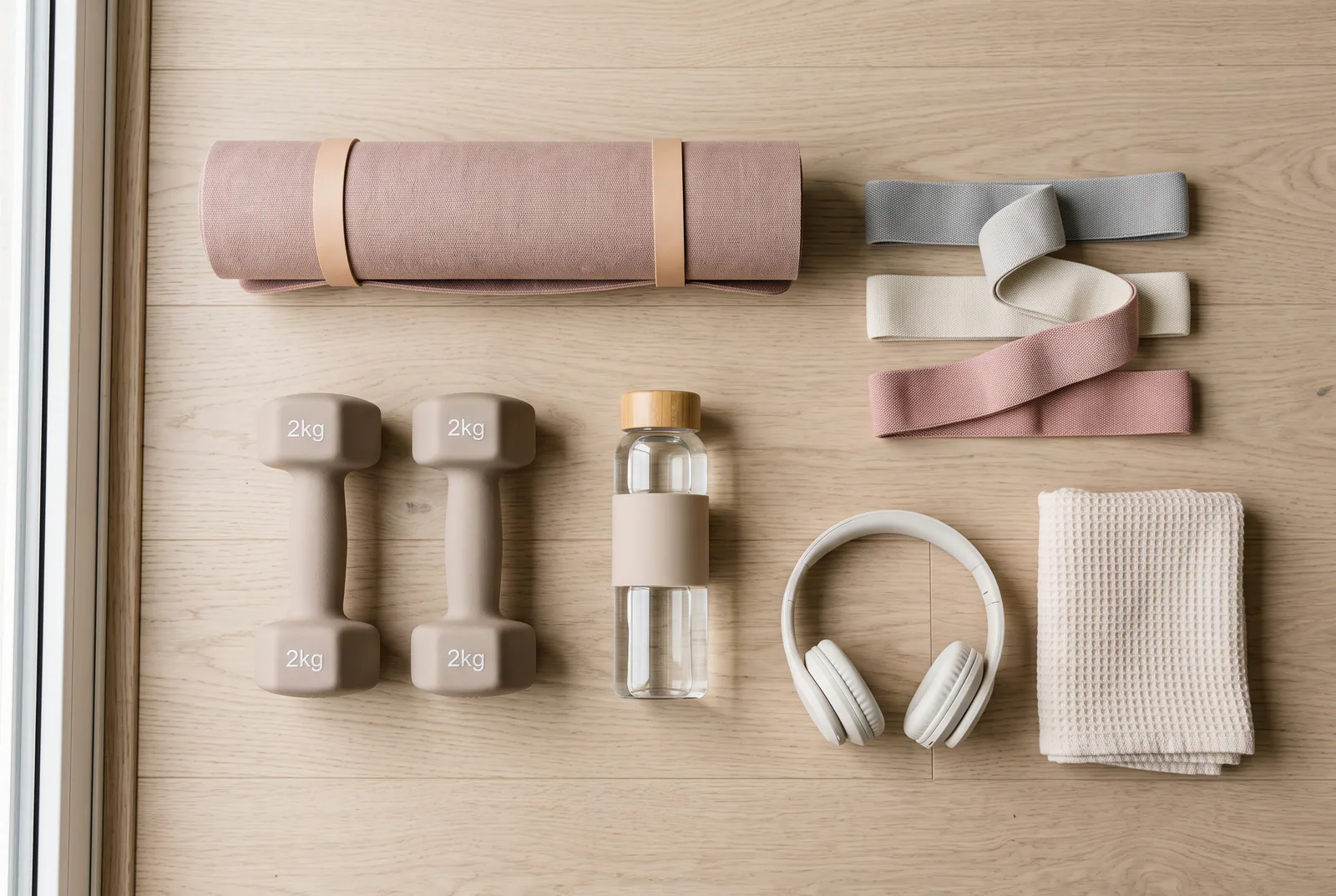
A pair or two of fixed dumbbells is often the simplest way to add resistance training to a home routine. There's no setup, no adjustment mechanism to learn, and they're ready to use the moment you pick them up. For someone just getting started, one or two pairs at a comfortable weight can cover a surprising number of exercises.
The trade-off shows up as you progress. Building a full range of weights — say, five or six pairs to cover different exercises — adds up quickly in both cost and floor space. Rubber-coated hex dumbbells, like those from Rogue, are a durable, floor-friendly classic reference point for this category, but they aren't necessarily the right small-space choice once you need more than a couple of pairs. That's usually the point where adjustable dumbbells start to make more sense.
4. Adjustable Dumbbells
For readers who expect to keep progressing in weight, adjustable dumbbells are arguably the strongest space-saving investment in this entire list. A single pair replaces what would otherwise be a whole rack, which matters in an apartment or a shared room.
One well-known example is the BowFlex SelectTech 552, which adjusts across a wide weight range using a rotating dial rather than manually swapping plates — useful for changing loads quickly between sets. The trade-off is that the housing around the weight plates stays the same overall size no matter how light you set it, so even at a low weight the dumbbell is bulkier in the hand than a fixed dumbbell of the same weight would be. Other adjustable systems solve this differently: some use a block-style stacking design instead of a rotating dial, and others use an internal mechanism that keeps the dumbbell closer to a traditional shape as the weight changes. The right pick depends more on how the dumbbell feels in your hand during pressing and curling movements than on the number of increments it offers.
Smart Strength Upgrades
The next two categories are genuinely useful once a routine is consistent, but neither is required to begin.
5. Kettlebell
A kettlebell isn't essential if dumbbells already cover your strength work, but it opens up movement patterns that dumbbells don't do as naturally — swings, goblet squats, and carries in particular, all of which train the body as a coordinated unit rather than isolating one muscle at a time.
Within the category, the main decision is value versus long-term durability. Mid-range kettlebells, like those from REP Fitness, offer solid quality at a lower price point. Premium options, like Rogue's line, use a more refined casting process that holds up better to repeated impact, which mostly matters if you're doing high-volume or high-impact kettlebell work regularly. For most home routines, either approach is a reasonable place to start — the category matters more than the specific brand.
6. Foldable Bench
A bench adds real exercise variety — presses, rows, and other movements that are awkward or impossible without one — but it's the kind of purchase that pays off once you're already training consistently, not before.
Foldable models, like the FLYBIRD bench, are designed specifically for smaller spaces: the legs fold flat so the bench can slide under a bed or into a closet rather than taking up permanent floor space. One practical note worth passing along: lightweight folding benches can shift slightly on smooth or hardwood flooring during heavier or off-center lifts, so pairing one with a mat or a rubber floor tile underneath tends to make it feel more stable.
Compact Cardio Options
These two options serve very different purposes, and the right one depends on your space and preferences more than anything else.
7. Jump Rope
A jump rope is about as low-footprint as cardio equipment gets — it takes up almost no storage space and works on nearly any floor. A basic adjustable rope is genuinely enough for most beginners and covers general conditioning perfectly well.
Weighted, precision-built ropes, like the Crossrope Get Lean set, are a premium option built around quick-swap weighted cables and smoother-spinning handles, which some more advanced users prefer for higher-intensity interval work. It's a nice upgrade if you're already jumping rope regularly and want a more refined feel, but it isn't something a beginner needs to start with.
8. Walking Pad
A walking pad is an optional convenience, not a home workout essential. It's worth mentioning here because it solves a specific, common problem: fitting low-intensity movement — walking while working at a standing desk, or a short walk when going outside isn't practical — into a small space. Most walking pads are designed to slide under furniture or store vertically against a wall, which is their main appeal over a full-size treadmill.
MERACH is a common name in this category, but it's worth noting that MERACH sells several different walking pad models, and they vary in motor power, noise level, and incline capability. Treat any specific number you see online — decibel level, horsepower, top speed — as tied to one particular model, not the brand as a whole. In general, this category is built for quiet operation and portability rather than running speed, which is worth knowing if your goal is walking rather than jogging or sprinting.
What You Probably Do Not Need Yet
It's easy to assume a "real" home gym needs a power rack, a full-size treadmill, a wall of dumbbells, or a collection of single-purpose machines. For most beginners, none of that is necessary yet — and some of it may never be, depending on your goals.
That doesn't mean this equipment is bad. A power rack is genuinely useful for someone doing barbell training with heavy squats and bench presses. A full-size treadmill makes sense for a dedicated runner. The point is that these are advanced or goal-specific purchases, not a starting point. They take up significant space, cost considerably more, and solve problems most beginners haven't run into yet. It's worth waiting until a specific, recurring need makes the case for one clearly.
Starter Setups by Budget and Space
Rather than a shopping list, here's a rough sense of how to sequence purchases as your routine grows. Exact totals will shift with pricing, so think of these as logical starting points rather than fixed budgets.
Minimal budget: a mat, a set of resistance bands, and one pair of fixed dumbbells. This is the lowest-friction way to start a home routine and covers a genuinely wide range of exercises.
Small-space strength: a mat, resistance bands, and a pair of adjustable dumbbells in place of multiple fixed pairs. This combination fits the core idea of this guide best — versatile, compact, and able to grow with you.
Strength-focused: adjustable dumbbells, a foldable bench, and optionally a kettlebell. This tier makes sense once you're training consistently and want more exercise variety.
Cardio add-on: a jump rope for minimal cost and footprint, or a walking pad for indoor walking and desk use — generally not both at once unless you have a clear reason for each.
Small-Space Home Gym Tips
A few practical habits make a bigger difference than any single product:
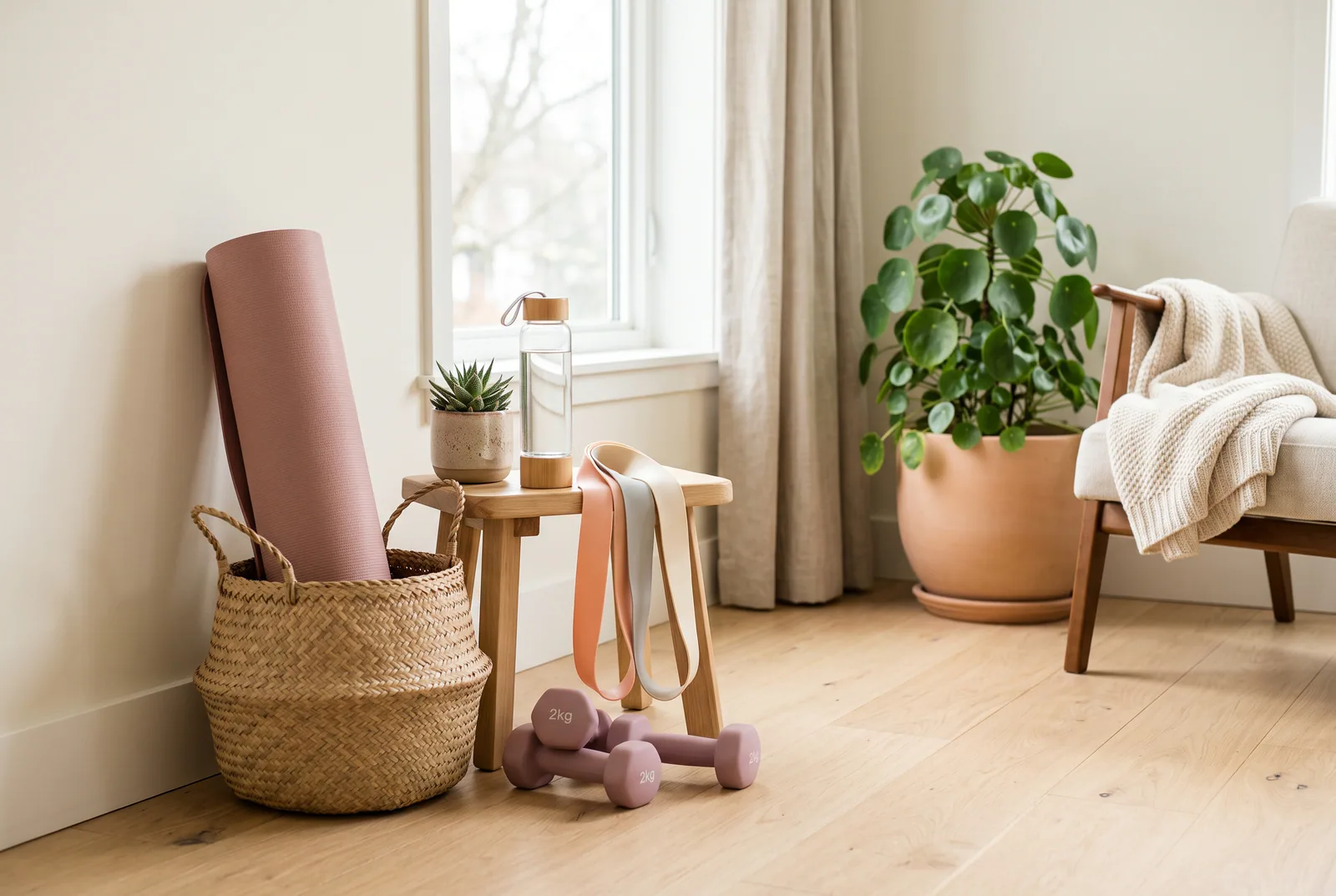
- Favor multipurpose equipment. A bench that folds flat or a mat that doubles as a step earns its space more easily than something with one narrow use.
- Use vertical storage. Wall-mounted hooks or a slim shelf keep bands, a mat, and light dumbbells out of the walking path without needing floor space.
- Avoid duplicate equipment. It's easy to end up with three types of bands or two sets of light dumbbells. Check what you already own before adding more.
- Prioritize foldable or compact options when comparing similar products, especially for anything that has to be put away after each session.
- Measure your space before buying anything large, like a bench or a walking pad, rather than estimating.
- Keep frequently used equipment easy to reach. Gear that's buried in a closet gets used less than gear that's visible and accessible.
Frequently Asked Questions
What home workout equipment should I buy first?
A mat, a set of resistance bands, and one or two pairs of dumbbells cover the most ground for the least cost and space. Everything else can wait until you know what your routine actually needs.
Do I need expensive equipment to work out at home?
No. A basic mat, bands, and a modest pair of dumbbells are enough to build a genuinely effective routine. More expensive equipment tends to add convenience or variety, not a requirement to get results.
Are adjustable dumbbells worth it for a home gym?
For most people who plan to keep progressing in weight, yes — a single pair replaces what would otherwise be several sets of fixed dumbbells, which matters when floor space is limited. If you only need one or two weights long-term, fixed dumbbells can be simpler and cheaper.
Can I get a good workout at home without machines?
Yes. A mat, resistance bands, and a set of dumbbells cover strength, mobility, and general conditioning without any machines. Machines add convenience for specific movements, but they aren't required to train effectively.
What equipment is best for a small apartment?
Prioritize compact and foldable items: a mat, resistance bands, adjustable dumbbells instead of multiple pairs, and a foldable bench if you add one later. A walking pad is a reasonable cardio option if a treadmill isn't practical.
Do I need both dumbbells and resistance bands?
Not strictly, but they complement each other well. Bands are useful for lighter, joint-friendly resistance and portability, while dumbbells allow for more direct progressive strength work. Many routines end up using both.
Do women need different home gym equipment than men?
Not fundamentally. The equipment itself doesn't need to be gender-specific — what matters is choosing the right weight range, grip comfort, and space-appropriate design for your own body and goals, which is true for anyone setting up a home workout space.